
Understanding Okeechobee County Releases
A release record marks the end of one agency's custody event. It does not always mean that the person went home or that every legal restraint ended. The Okeechobee County Jail can release someone to the community after bond, recognizance, a court order, charge clearance, or completion of a local term. The same jail can transfer a person to FDC, another county, the U.S. Marshals Service, ICE, a hospital, or another authority. A transfer ends the OCSO bed assignment while custody continues elsewhere.
Okeechobee Correctional Institution is a separate state prison. Its releases and transfers are recorded by the Florida Department of Corrections, not by the county jail roster. Federal sentenced custody belongs to BOP, federal pretrial movement belongs to USMS and the federal court, and immigration detention belongs to ICE. Juvenile releases are handled through DJJ-authorized and juvenile-court channels with stronger confidentiality limits. The operator and the disposition determine which record can prove what happened.
- Release
- The end of a specific custody event, either to the community or another status stated in the record.
- Discharge
- The end of a prison sentence or supervision term as defined by the responsible agency.
- Transfer
- A change from one custodian or facility to another, not a community release.
- Time served
- A court or sentence notation that the custodial part is satisfied by credit already earned.
Okeechobee County Release Types
The wording in the returned booking or release record matters. Bond ends the jail stay after stated conditions are met, yet the criminal case continues. A court-ordered or recognizance release can also leave hearings and conditions in place. Time served or sentence complete ends the custodial part described by the order. Dismissal, nolle prosequi, or no information is a court event that may explain the release, but the docket and jail transaction answer different questions.
| Record notation | Meaning | Next source |
|---|---|---|
| Bond or recognizance | County custody ends under pretrial conditions | OCSO release record and OCRS docket |
| Time served or sentence complete | Named custodial term has ended | Release transaction and sentencing order |
| Transfer to FDC | State prison custody begins or continues | FDC Corrections Offender Network |
| USMS or ICE transfer | Federal or immigration custody may follow | Federal court, USMS, BOP, or ICE |
| Parole or conditional release | Prison confinement ends while supervision continues | FDC supervision record and FCOR action |
| Hospital, escape, or death | Exceptional departure, not ordinary release home | Exact agency record and corroborating source |
A person can also remain bound by probation, community control, registration, a detainer, or another case. Read the receiving-authority field and current supervision data before describing an Okeechobee County released inmate as free of custody or supervision.
Okeechobee County Release Record Fields
An OCSO request should seek the existing booking sheet and the fields that document the actual departure. The request can name the desired facts without claiming that OCSO uses those exact database labels. The returned record controls. A court order can establish legal authority for release, while the jail transaction supplies the time staff processed it.
| Requested field | What it helps establish |
|---|---|
| Committed name and aliases | Identity used for the booking |
| Booking number and date | The specific county custody event |
| Charges and case numbers | Links the jail stay to the court docket |
| Bond and hold information | Conditions or barriers affecting departure |
| Actual release date and time | When OCSO processed the end of custody |
| Release type or disposition | Bond, order, completion, transfer, or another outcome |
| Receiving authority or destination | Whether custody continued with another agency |
| Booking photograph | Identity context for the booking, requested separately if needed |
The Okeechobee court docket may show a dismissal, plea, judgment, sentence, credit, probation order, revocation, termination, or closure. It does not prove the minute OCSO completed release. VINE can report a status change, but it is not a certified transaction record. For a state prisoner, the FDC detail carries state release and supervision information rather than the county booking record.
Request Okeechobee County Release Records
The OCSO Records Request page offers email, telephone, a GOVQA portal, and in-person access. Records staff review requests Monday through Friday from 8:00 a.m. to 5:00 p.m., excluding holidays. The published local rate is $0.15 per page and $15 per hour for lengthy research, with prepayment. OCSO does not promise a fixed completion period, so a narrow request and an advance estimate are useful.
- Identify the person by full name, aliases, date of birth if known, approximate booking date, and booking number if available.
- Ask for the existing booking sheet, actual release date and time, disposition, and any receiving agency or detainer disposition needed to distinguish transfer.
- Request the booking photograph separately when it is needed, along with electronic delivery and lawful redactions.
- Ask for a cost estimate before work begins and the statutory basis for any withheld part.
504 NW 4th Street
Okeechobee, FL 34972
863-763-3117
records@okeesheriff.com
The official OCSO contact screen shows the request channels and records contact.
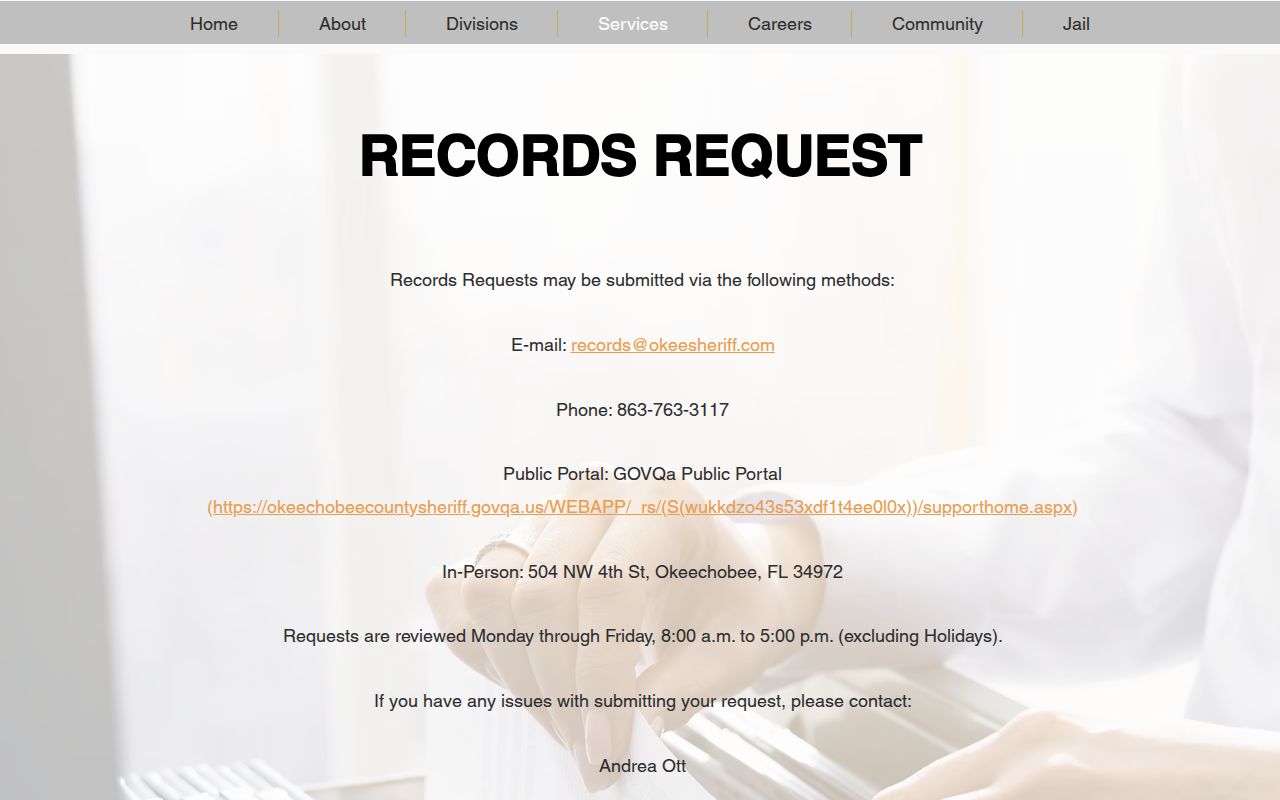
The screenshot supports the local route rather than substituting for the record returned by OCSO.
Okeechobee Release Records Law
Florida Constitution Article I, section 24 and Chapter 119 provide broad public access subject to specific exemptions. Florida Statutes section 119.07 requires prompt acknowledgment and a good-faith response. When only part of a record is exempt, the custodian redacts the protected part and produces the rest. A denial must identify its statutory basis.
An online display window is not a retention rule. Section 119.021 and the GS2 schedule govern minimum retention categories, while legal holds and other rules can extend them.
Juvenile, sealed or expunged, active investigative, victim, medical, and other protected information may be withheld or redacted. A sheriff booking photograph is generally a public record unless a specific rule protects it. Broad labels should not replace a record-specific statutory explanation.
Okeechobee Bond Release Meaning
Bond-out is conditional pretrial release, not dismissal or completion of the case. Okeechobee lies in the Nineteenth Judicial Circuit, whose active 2026 schedule separates categories eligible for discretionary release before first appearance from categories that require first appearance. A judge still makes the individual decision under the applicable law and facts.
The OCSO release record proves when the jail processed the event. OCRS shows later hearings, pleas, dismissals, or sentence action. Cash-bond accounting after the case is separate: the clerk may apply cash bond funds to unpaid clerk costs or return the balance to the depositor. Neither result establishes the physical release time.
Okeechobee Court Release Records
The Okeechobee OCRS criminal docket is the correct anonymous case-search channel. Landmark is a recorded-instrument index, not the criminal docket. OCRS may show a bond order, dismissal, no information, nolle prosequi, sentence, time-served credit, probation, revocation, termination, or closure. Those entries explain legal action but do not create an OCSO release timestamp.
The official OCRS access screen shows the criminal-case route and search fields.
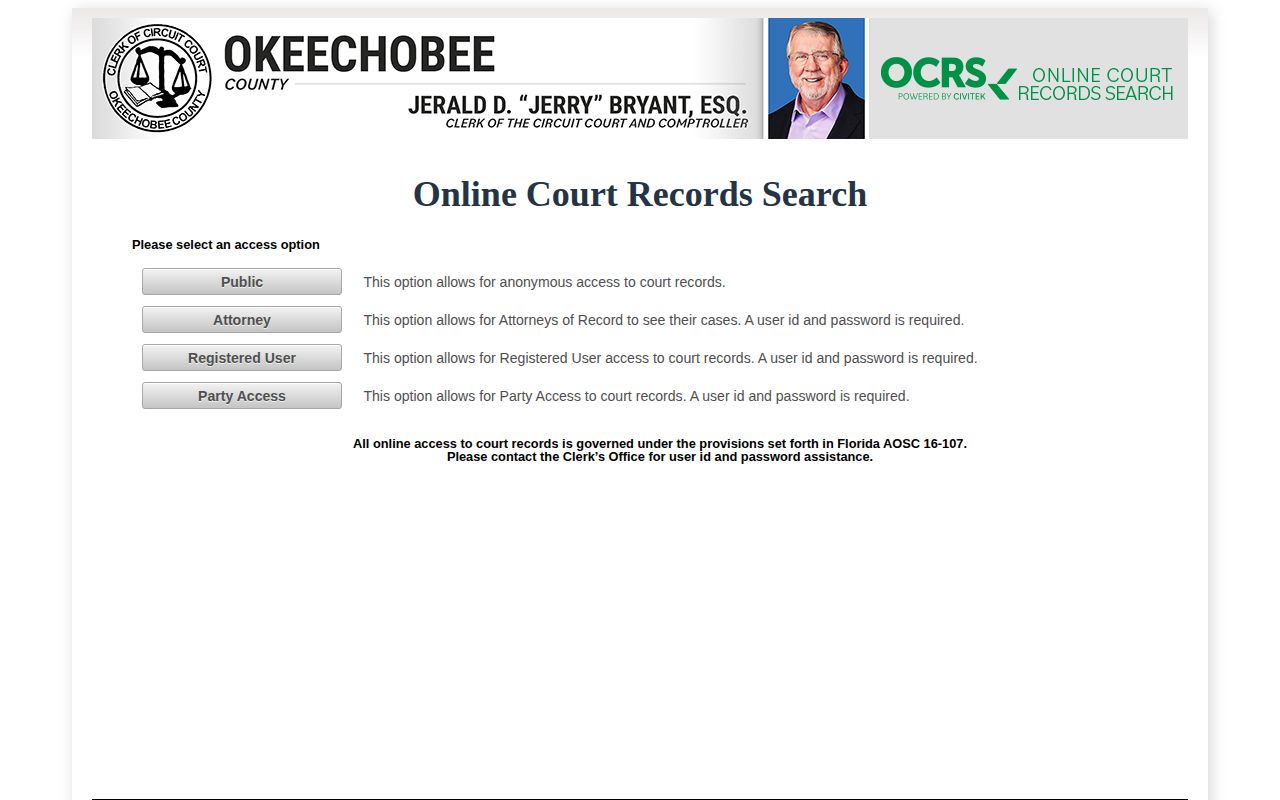
A certified disposition comes from the Okeechobee Clerk when certification matters.
Okeechobee Release Record Sealing
The local seal or expunge path starts with a certified Okeechobee disposition and an FDLE Certificate of Eligibility. FDLE requires its application materials, eligible case dispositions, a fingerprint card, proof that applicable supervision ended, and the stated fee. The certificate is only an eligibility stage. Relief begins after a court order and delivery of the certified order to FDLE.
Sealing makes the covered record confidential and exempt from ordinary access. Expunction generally requires agencies to destroy or obliterate covered copies subject to statutory exceptions, while FDLE retains a confidential copy. Automatic state criminal-history sealing does not itself seal local court or agency files. The Okeechobee Clerk says later access to a sealed or expunged case requires a motion to reopen.
Find Okeechobee County Released Inmates
The search begins with the custodian, not with a broad name result. OCSO's page labeled Inmate Search is an aggregate Booking Statistics chart with no names or status fields. It cannot show who is now held or who was released. The absence of an official person-level feed makes the transaction record and court docket central to a county-jail search.
- Search the Okeechobee OCRS criminal docket for the correct person and case, then read the newest custody-related order or disposition.
- Check Florida VINELink by name and identifier. Treat an alert or out-of-custody status as a signal to confirm with the agency.
- Request the OCSO booking sheet, actual release date and time, disposition, and receiving authority.
- If the record says FDC, federal, or ICE transfer, continue in that receiving system instead of calling it community release.
- For active state supervision, match the DC number in FDC's Supervised Population search and confirm the office.
A released person normally leaves a current custody display. A transfer can do the same, so disappearance alone never proves release home.
Use several identifiers before accepting a match: booking or DC number, date of birth or age, case number, photograph, physical description, and offense dates as available. When sources conflict, the agency responsible for that exact custody event should be asked for its underlying record. The Okeechobee 24-hour releases page addresses same-day verification when no public feed exists.
FDC Okeechobee Release Search
The FDC Corrections Offender Network covers felony offenders sentenced to state prison or state supervision, including current and prior offenses. It excludes county-jail-only sentences and county probation. That boundary is vital: an Okeechobee County Jail release may have no FDC result unless the person later entered state jurisdiction.
| Search field | How it works | Use |
|---|---|---|
| Last name | Prefix search | Required starting point when no number is known |
| First name | Prefix search | Narrows a common surname |
| DC number | Six characters | Preferred unique FDC identifier |
| Aliases | Optional expansion | Checks other committed names |
| Photograph filters | Show photo records or suppress list photos | Supports identity comparison |
Open the person detail and read current status, inmate release information, offenses, sentences, and supervision together. FDC calls the public value Release Date. For a future term-of-years date, Florida law calls the gain-time projection the tentative release date. It can change after credits, gain-time awards or forfeitures, corrected judgments, detainers, consecutive terms, or other official updates.
The official FDC inmate release search shows its released or scheduled-release scope and nightly update notice.
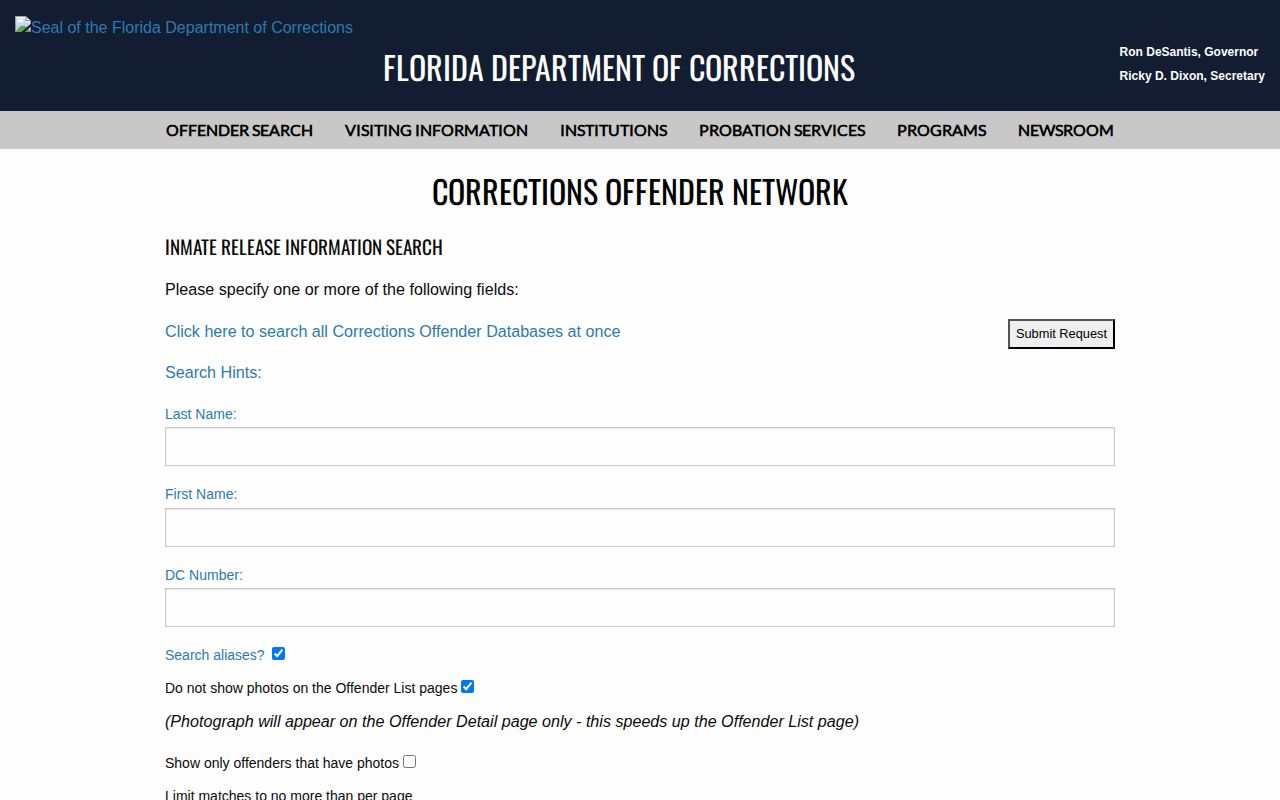
The FDC screen is appropriate for state prison history, not for a county-only jail event.
Okeechobee County Recent Releases
As of the research date, OCSO published no official 24-hour or 72-hour person-level release list. Its inspected Inmate Search page resolves to a Google Sheets Booking Statistics chart grouped by booking type. It has no name, booking number, release date, custody status, disposition, charge, bond, destination, photograph, refresh promise, or archive window.
The negative finding does not mean an internal record does not exist. It means the public web page cannot answer the question. Same-day checks use the jail line for whether custody continues, VINE for a supplied movement event, the court docket for an order, and an OCSO request for documentary release proof. A date-range request should ask for existing releasable records within stated dates rather than demand that OCSO create a custom list.
Does the sheriff app supply the missing list? The current app-store descriptions list reporting, resources, contacts, social channels, and press releases. They do not advertise inmate lookup, releases, or mugshots.
Okeechobee Post-Release Supervision
Probation is imposed by a court. Parole is an FCOR release before sentence expiration for a limited eligible population. FDC Community Corrections also supervises community control, conditional release, conditional medical release, and other state terms. A prison release date does not prove that supervision ended.
Search FDC's Supervised Population database with the DC number, open the matching detail, and read the type, active or terminated status, dates, and office. Okeechobee's adult Office 193 is at 800 South Parrott Avenue and can confirm the current reporting office after identity is established. An Absconder/Fugitive result means the person stopped making themselves available for supervision. It does not prove current custody or, by itself, certify an executable warrant. The complete verification sequence appears on the Okeechobee post-release supervision page.
Okeechobee Release Alerts and Transfers
Florida VINE covers all county jails as well as FDC and DJJ. It can report release, transfer, escape, death, or another movement supplied by the participating agency. Alerts help with timing, but feed labels and delays vary. Confirm an OCSO event with OCSO, an FDC event with FDC, and a juvenile event through authorized DJJ channels.
Federal systems are separate. The BOP locator covers federal inmates from 1982 forward and can show a release date plus Released or Not in BOP Custody. Those words only show that BOP no longer holds the person. USMS handles federal pretrial prisoners and has no comparable public name archive, so the federal court order and a USMS records request may be needed. ICE's locator covers current detainees and people released from ICE custody during the preceding 60 days. After that window, use ICE records or immigration-case documents.
An OCSO disposition that names ICE is a transfer, not proof that the person returned to the community. Search ICE with the A-number and country of birth or with exact biographical data. Minors are excluded and not every person appears.
Okeechobee Release Search Comparison
No single result establishes every custody status. Match the source to the operator and the point in the case:
| System | Best use | Main limit |
|---|---|---|
| OCSO jail line | Immediate current-hold question | Not historical documentary proof |
| OCSO release record | Actual county departure and disposition | Must be requested; no public name feed |
| Okeechobee OCRS | Court order, sentence, or case disposition | Not the physical release minute |
| FDC offender search | State prison release and state supervision | Excludes county-only custody |
| VINELink | Movement alert and status cross-check | Can lag and is not a certified record |
| BOP locator | Federal sentenced-custody release date | Not county, USMS pretrial, or ICE custody |
| ICE locator | Current or recent ICE custody | Released-person display lasts 60 days |
A name-only match is weak. Confirm the identifier, date of birth or age, case number, photograph, and offense date where those fields are lawful and available.
Okeechobee County Release Facilities
The facility map includes local, state, juvenile, federal, and immigration routes because an Okeechobee case can move between systems. Each link uses the verification process for that operator:
- Okeechobee County Jail holds local adult detainees and county sentences; OCSO supplies the release transaction.
- Okeechobee Correctional Institution is an FDC state prison; FDC supplies the release and supervision history.
- Everglades Youth Academy is a DJJ residential commitment program with juvenile confidentiality limits.
- St. Lucie Regional Juvenile Detention Center serves Okeechobee youth before court or placement.
- The federal BOP system, USMS Southern District of Florida, and the ICE system cover distinct federal or immigration custody events.
Two Okeechobee Release Systems
The county contains a 344-bed sheriff jail and a separate 1,632-capacity state prison. The similar geographic names make them easy to confuse. OCSO's four-unit jail handles local bookings and county custody. Okeechobee Correctional Institution houses people serving FDC sentences who may come from any Florida county.
Older audit material described the state prison's Main Unit, Work Camp, and Sago Palm configuration. Current FDC directory naming controls, so those dated components should not be treated as three current prisons. The official FDC institution page is the source for current facility identity and capacity.
Travel After Okeechobee Release
The City of Okeechobee lists the Amtrak station at 801 North Parrott Avenue and directs travelers to Amtrak or 800-872-7245 for schedules and tickets. It is a concrete transportation option within the city after release.
No official source says the jail transports released people to that station, identifies a family pickup zone, uses a stated exit, or permits waiting at a particular location. Ask OCSO about current logistics before making plans, and keep the travel option separate from proof that release occurred.