
Okeechobee Projected and Actual Release
FDC's public interface uses the label Release Date. When that date is still in the future, it is a projection based on the sentence and data then available. Florida Statutes § 944.275 uses more precise terms. The maximum sentence expiration date, or MSED, reflects a term-of-years sentence after lawful custody credit. The tentative release date, or TRD, is the gain-time projection after credits, grants, restoration, or forfeiture are applied.
An actual release is a completed custody event. The date can differ from a prior projection when FDC receives a corrected judgment, applies jail credit, recalculates combined sentences, records a forfeiture, or identifies another legal constraint. The agency's offender search also warns that location, status, and release information can change too fast for the public display to remain exact at every moment.
A county jail event follows a different path. Okeechobee County Jail holds pretrial detainees and people serving local sentences. A person may leave on bond, court order, time served, sentence completion, dismissal or clearance of holds, or may transfer to another authority. OCSO's public page does not publish a named roster or projected-date field. Never apply the FDC prison calculation to a local jail record.
Find Okeechobee Projected Release Dates
Start by identifying the operator. Okeechobee Correctional Institution is an FDC state prison. Okeechobee County Jail is an OCSO local jail. The shared place name can lead to the wrong search, yet each agency maintains a different release record.
- Determine whether the person is in OCSO county custody, FDC state custody, juvenile custody, or a federal system.
- For an FDC prisoner, open the dedicated released and scheduled-release search. Use the DC number when possible, or search the name and compare the full identity record.
- Read the FDC inmate release-information portion and the current status. Treat a future Release Date as the current projection, not a promise.
- For an OCSO detainee, check the court docket and ask OCSO for the existing release record. A pretrial case may not have any set departure date.
- Confirm a material state date with FDC Admission and Release. Confirm a county event with OCSO and the court as the facts require.
The FDC search accepts last name, first name, or a six-character DC number. Name fields use prefix matching, so partial beginnings return names that start with those letters. The search can include aliases and can limit results to records with photographs. Identity must be confirmed before any date is attributed to a person.
The FDC released and scheduled-release search documents the direct date route and its update warning.
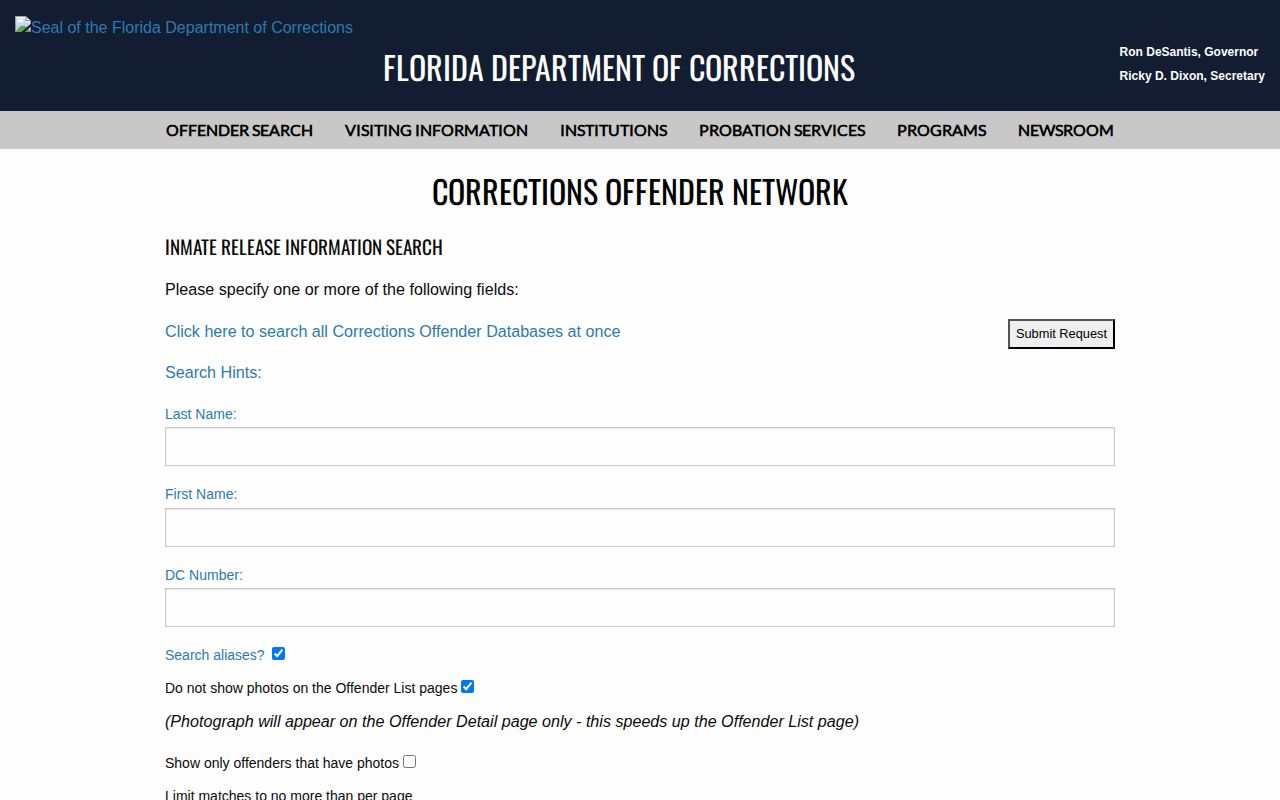
The screen supports a state-prison release date lookup, but it expressly does not turn county-jail custody into an FDC record.
Okeechobee Jail Release Date Limits
A pretrial detainee does not have a sentence-based projected release date. The timing can depend on a bond decision, first appearance, later court order, dismissal, resolution of a hold, or transfer. Even a bond amount does not prove when release processing will finish. Okeechobee's court docket can show orders and case disposition, while OCSO controls the physical jail release record.
The official OCSO site supplies an “Inmate Search” link, but the resolved object is only an aggregate Booking Statistics chart. It has no person name, booking number, current status, release time, reason, destination, or projected date. A person cannot be declared released merely because no named result appears. The website does not publish the jail's release-processing hour, weekend procedure, exit point, property-return policy, or county good-time rule.
Request existing OCSO records rather than asking the custodian to calculate a date or create a report. Supply the full name, aliases, birth date if known, approximate booking date, and booking number if available. For a completed event, request the booking sheet and fields showing actual release date and time, release disposition, and any transfer destination or detainer disposition. OCSO Records accepts requests at records@okeesheriff.com, 863-763-3117, its GOVQA portal, or 504 NW 4th Street.
Note: No researched OCSO source supports a public projected-date calculator, fixed weekend rule, or county-jail good-time formula.
Florida Gain Time for Okeechobee
Florida does not use one universal good-time percentage. Section 944.275 divides incentive gain time by offense date. For older pre-1994 sentences, the statute can allow up to 20 days per month under the applicable regime. For offenses from January 1, 1994 through September 30, 1995, the ceiling can be up to 25 days per month for former severity levels 1 through 7 and up to 20 days for levels 8 through 10. For offenses on or after October 1, 1995, incentive gain time is up to 10 days per month.
Basic gain time of 10 days per month belongs to an older offense-date band that starts July 1, 1978 and ends before January 1, 1994. It must not be described as an automatic credit for a modern prisoner. Meritorious gain time can range from 1 through 60 days for an outstanding deed or service. A separate one-time educational award can provide 60 days to an otherwise eligible prisoner who meets the statutory requirements.
Some defined sexual and child-offense groups face incentive-gain-time exclusions under the offense-date rules. Rather than relying on an incomplete list, check the live statute and FDC calculation. Sentence law, eligibility, and the offense date matter as much as the nominal length of the sentence.
The operative Florida gain-time statute contains the calculation rules and service floor.
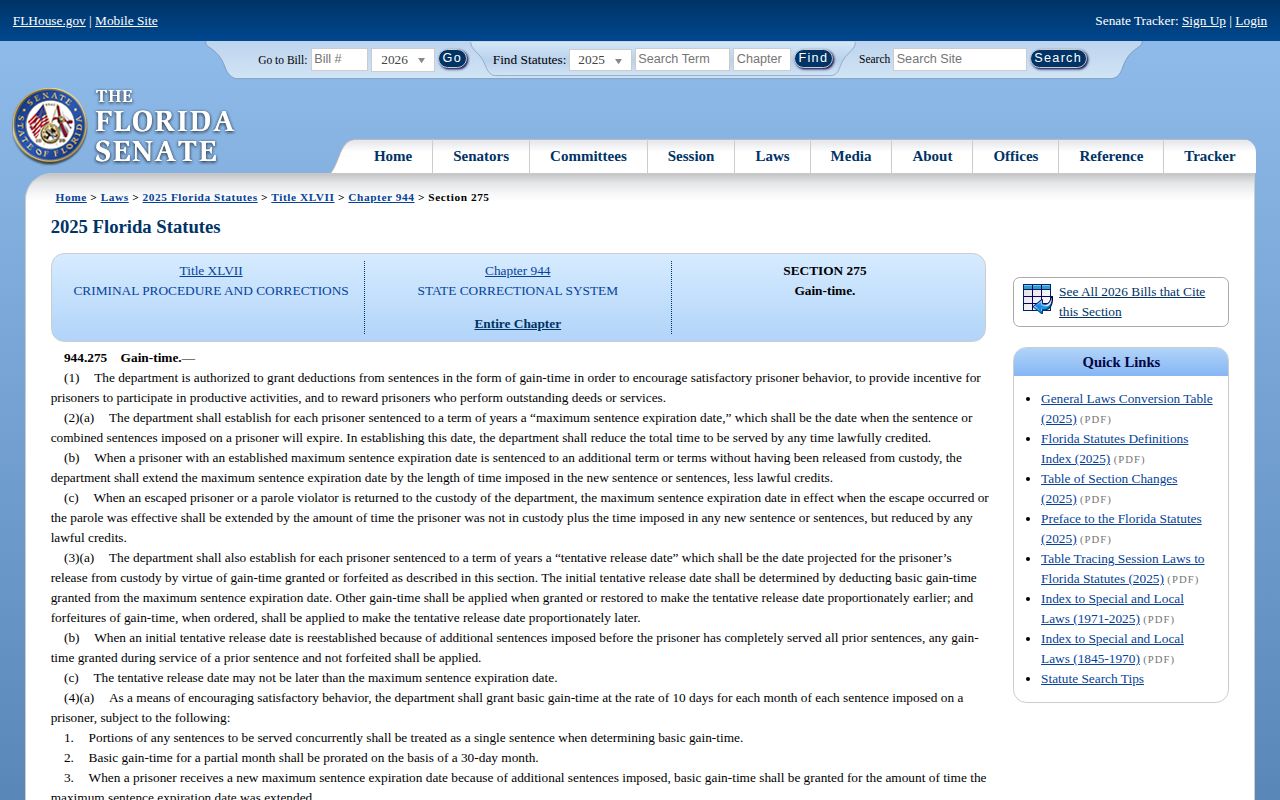
The statute explains why FDC's current calculation controls instead of a simple sentence-minus-percentage estimate.
Okeechobee Release Date Service Floor
For people in the post-October 1, 1995 incentive-gain-time regime, § 944.275(4)(f) bars gain time from causing release before at least 85 percent of the sentence has been served. Court-awarded credit for time physically incarcerated counts in that calculation. Once the tentative release date reaches the 85-percent service point, gain time stops moving it earlier.
The rule is a floor, not a promise of a 15-percent reduction. A prisoner may be ineligible for awards, lose gain time, face a mandatory minimum, or serve a sentence requiring more time. A life prisoner remains for natural life absent pardon or clemency. Florida's Criminal Punishment Code also states that a covered sentence reflects actual time served, shortened only through lawful gain time and never below the service floor.
Florida Administrative Code Rule 33-601.101 implements incentive gain time. During the research, the official rule page also showed a later rule-development notice. Proposed development is not effective law. Use the final adopted text and current statute when a calculation is material.
Why Okeechobee Release Dates Change
The tentative date moves as the lawful inputs change. Section 944.275 provides that gain time granted or restored can move the date earlier, while forfeiture can move it later. The TRD cannot be later than the maximum sentence expiration date. Other changes arise from court records, sentence structure, or custody events that FDC must apply.
| Change | Possible effect | Best confirmation |
|---|---|---|
| Gain time granted or restored | May move the tentative date earlier within legal limits | Current FDC calculation |
| Gain time forfeited | May move the tentative date later | FDC record and applicable action |
| Corrected judgment or jail credit | Changes sentence inputs or credited custody time | Court record and FDC update |
| Consecutive or added sentence | Can extend the aggregate time | Court judgments and FDC aggregation |
| Mandatory minimum or legal exclusion | Can limit or block an earlier date | Judgment, statute, and FDC record |
| Detainer or transfer | Can change where the person goes after one custody ends | Sending and receiving agencies |
A parole action can also affect the legal release path for an eligible person, but an FCOR agenda or favorable future date is not a completed release. The written Commission action, effective date, and later FDC status must agree. Modern Criminal Punishment Code sentences generally do not use Chapter 947 parole.
Okeechobee Release Date Calculation
The safe conceptual sequence begins with the court sentence and aggregation rules. FDC then establishes the MSED after lawful custody credit. Eligible gain time, restoration, and forfeiture shape the TRD and visible future Release Date. The result remains constrained by the 85-percent floor, mandatory minimums, added or consecutive cases, and later court or FDC updates.
This sequence is not a home release calculator. A nominal sentence alone cannot reproduce the authoritative date. FDC may receive a judgment amendment or credit that is not visible in a basic docket summary. Its classification and release staff apply the record under current law.
- MSED
- The maximum sentence expiration date for a term-of-years prisoner after lawful credit.
- TRD
- The tentative release date after eligible gain time is granted, restored, or forfeited.
- Detainer
- A request or legal basis for another authority to take custody when the present hold ends.
- Actual release
- The completed departure recorded by the authority that held the person.
Confirm Okeechobee Release Date Records
For a state date that affects travel, pickup, or a legal filing, contact FDC's Bureau of Admission and Release at 850-488-9167 or dc.release@fdc.myflorida.com. Questions or corrections about offender data can go to the Bureau of Classification and Central Records at 850-488-9859 or central.classification@fdc.myflorida.com. Explain the record being checked and provide the DC number.
Florida VINE can send a later custody-change alert, but it is a notification system rather than the certified release record. The Okeechobee County VINE inmate check explains the one-person search, PIN, and agency-confirmation steps. For the broader distinction among county, state, and federal records, use the Okeechobee County released-inmate lookup.
A completed FDC release does not always mean the person is free of supervision. Read any separate supervised-population entry. Likewise, “Not in BOP Custody” or release from ICE custody describes only that agency's custody. A receiving authority, court condition, or supervision term may still apply.