
Okeechobee Parole and Probation
Florida uses several forms of adult supervision, and the terms are not interchangeable. Probation is a court-ordered sentence served in the community. Community control is a more restrictive court-ordered form of supervision. Parole is an early release decision made by the Florida Commission on Offender Review, or FCOR, for a limited group of eligible prisoners. Conditional release and conditional medical release also follow prison, but they arise under different legal authority.
The Florida Department of Corrections, or FDC, administers supervision in the community. Thus, FCOR may make a parole decision while FDC field staff supervise the person after release. A county judge may order probation without any prison term. Most people sentenced under Florida's modern Criminal Punishment Code are not eligible for parole. Their later community supervision may instead be probation or another lawful form shown in the FDC record.
| Supervision type | Who orders it | What to verify |
|---|---|---|
| Probation | A Florida court | Active or terminated status, dates, and FDC office |
| Community control | A Florida court | The current FDC supervision entry and office |
| Parole | FCOR for an eligible prisoner | FCOR written action, prison release, and FDC supervision |
| Conditional release | State release authority under Florida law | Release entry plus current FDC supervision status |
A release date and a discharge date are also different. Release marks departure from custody. Discharge marks the lawful end of a sentence or supervision term. Someone can have a past prison release date and an active supervision record on the same day.
- Parole
- Release before sentence expiration for a person who qualifies under Florida's limited parole laws.
- Probation
- Court-ordered community supervision that may be imposed with or without a prison term.
- Discharge
- The formal end of the applicable sentence or supervision obligation.
- Absconder
- A person who has stopped making himself or herself available to the supervising authority.
Check Okeechobee Supervision Status
FDC operates a dedicated Supervised Population search. It accepts a name or DC number, uses search fields parallel to the general offender search, and may display a photograph. The DC number is the strongest public identifier. Names can match more than one person, so compare the photograph and all lawful identity fields before reading the status.
- Search the FDC inmate release database first when the person left state prison. Record the DC number and the release date from the matching record.
- Open the Supervised Population search and use that DC number. If only a name is known, compare all available identifiers before selecting a record.
- Read the supervision type, status, dates, and office or location fields. An active record means prison release did not end FDC oversight.
- Call the listed office when current assignment matters. Office data can change after the public system is refreshed.
- If an absconder result appears, verify it through FDC or law enforcement. Do not treat the web entry as proof of present custody.
FDC reports a weekly full refresh for the supervised population data and nightly changes for termination dates and locations. That schedule helps explain why a recent office move may not appear at once. The public record is useful, but the supervising agency remains the source for current status.
The official supervised population form shows the fields and scope used for this check.
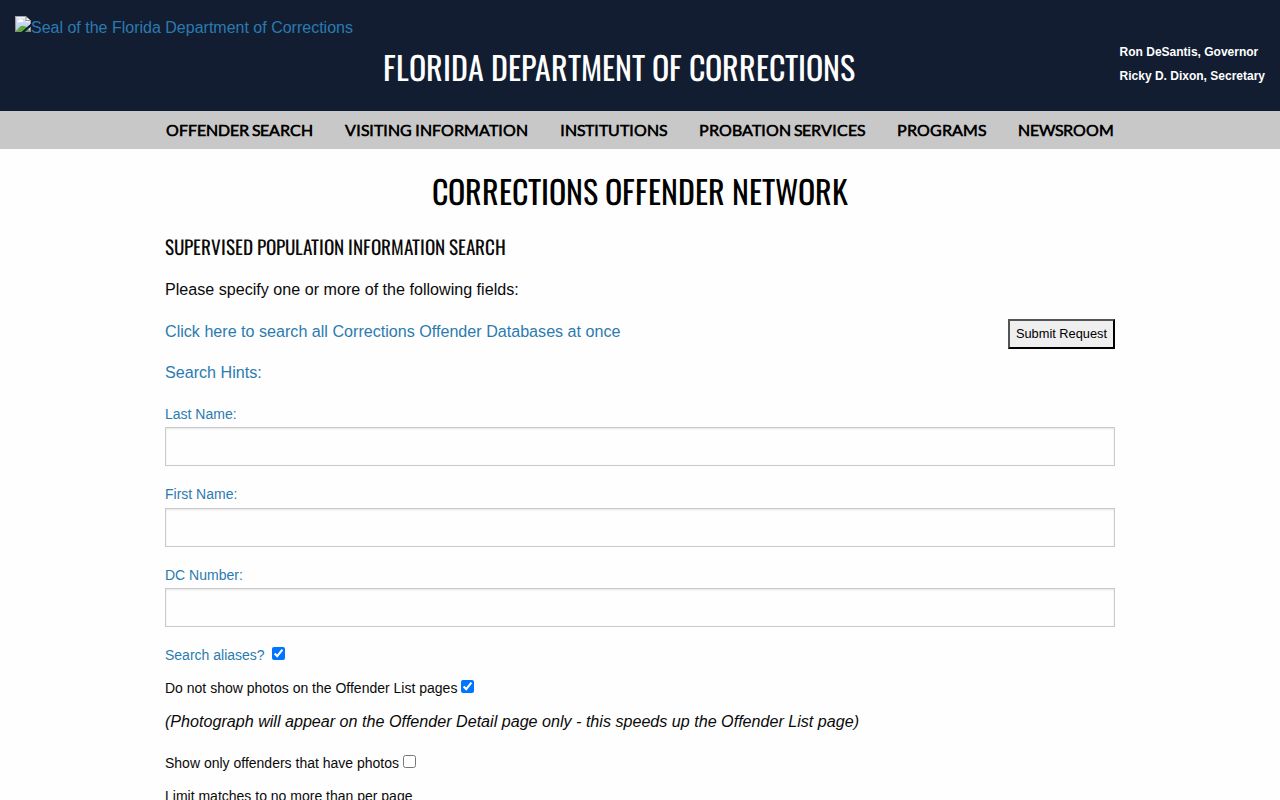
The form supports a focused supervision search after identity and the prison release event have been matched.
Okeechobee Release Supervision Office
Okeechobee County belongs to FDC Community Corrections Circuit 19, along with Indian River, Martin, and St. Lucie Counties. FDC lists a dedicated local unit. Office 193 is the practical contact after a public search identifies an active adult supervision record. The office can confirm the current reporting office without turning a prison release date into an assumption about discharge.
FDC Office 193, Okeechobee
800 South Parrott Avenue
Okeechobee, FL 34974
Phone: 863-462-5304
Fax: 863-462-5176
Central Field Services: 850-717-3444
co-supervision@fdc.myflorida.com
Adult FDC supervision must not be confused with the Department of Juvenile Justice probation program for youth. Juvenile records and contacts follow different access rules. Start with the agency named in the actual case or release record.
The FDC Circuit Office List documents the local entry.
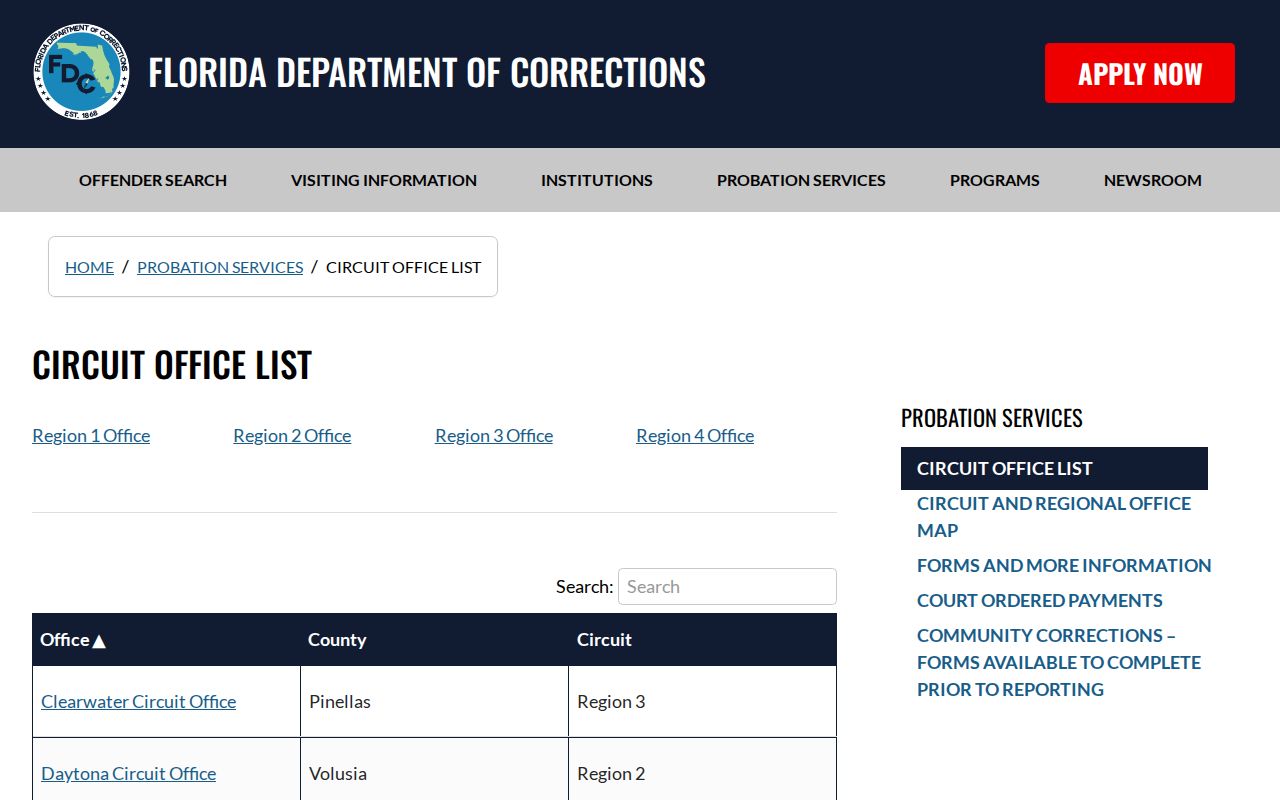
The listing ties Okeechobee County adult supervision to Office 193 instead of a county jail or juvenile office.
Okeechobee Absconder Record Checks
An active supervision entry does not disclose every condition imposed by a court, FCOR, or FDC. Conditions may require reporting, lawful travel approval, treatment, payment, or compliance with a release order. The governing judgment and supervision documents control. A violation allegation may lead to review, a warrant, arrest, modification, revocation, or another legal result, but the public search alone does not establish which result occurred.
FDC maintains a separate Absconder/Fugitive search. It also receives weekly full refreshes plus nightly termination and location changes. An absconder listing means the person stopped making himself or herself available for supervision. It does not prove the person is now jailed, and it is not certified proof of an executable warrant.
Florida VINE may provide custody-change notices when a participating jail or corrections system reports an event. It is not a supervision-condition database. Use the FDC supervision search for the legal status, then use the holding agency for any later custody event.
Okeechobee Parole Decision Records
FCOR is Florida's parole decision-maker. Its public voting schedule is a rolling calendar with frequent meetings rather than a promise of one fixed weekday. A meeting agenda can show a person's name, DC number, case category, county, offense, and the type of matter presented. Categories such as initial interview, subsequent interview, effective interview, supervision review, or final hearing do not reveal the result.
The official source sweep found no public post-hearing results database. The reliable outcome is FCOR's written action, order, or notice. Request that record from the Commission Clerk at 850-488-1293 or fcorlegal@fcor.state.fl.us. The public-records line is 850-848-4460. Then check FDC after any effective date. A favorable vote or future authorized date is not proof that a person physically left prison.
Florida law permits outcomes such as grant, denial, or revocation, and it governs action on a presumptive parole release date. Modern prisoners are generally outside parole eligibility. FCOR's release information describes the principal older and narrow later-date groups, while the underlying offense date and sentencing regime decide eligibility.
Note: Never read an FCOR agenda as a release list; the written action and later FDC custody record establish what happened.
Okeechobee Supervision Discharge Records
Supervision ends through a lawful discharge or other recorded termination, not merely because a prison release date has passed. The FDC Supervised Population record may show active or terminated status and relevant dates. When the public entry is unclear or stale, request the existing FDC record or contact the supervising office. A court docket can establish what a judge ordered, while an FCOR written action can establish the Commission's decision.
A former Okeechobee County Jail detainee may never appear in the FDC supervised population data. FDC states that its offender network does not cover people sentenced only to county jail, county probation, or other non-FDC supervision. For a local jail event, the Okeechobee County Sheriff's Office release record and court docket are the right starting points. The full county-jail and state-prison distinction is covered in the Okeechobee County released-inmate search.
Florida public-record law allows access subject to specific exemptions and lawful redaction. If only part of a requested record is protected, the custodian produces the remainder when the law allows. Ask for the record that shows termination or discharge, identify the person and case with care, and request the legal basis for any withheld part.
Why Okeechobee Office 193 Matters
Okeechobee has a dedicated adult supervision office rather than requiring every status question to be routed through another Circuit 19 county. That local entry matters because a released person's FDC record can show a supervision location that later changes. The public search should identify the person first. Office 193 can then confirm whether it remains the correct local office.
The office covers both court-ordered supervision administered by FDC and supervision that follows prison. That does not make all cases parole. Read the supervision type in the record, identify who imposed it, and use the relevant court or Commission document when the legal basis matters. This sequence prevents a prison departure, a county probation sentence, and a parole action from being blended into one label. Current office confirmation also guards against relying on an older location entry.