
Okeechobee Jail Release Routes
Okeechobee County Jail is the adult local jail run by the Okeechobee County Sheriff's Office, or OCSO. It receives people arrested on local matters and can hold people serving county sentences. A departure from the jail has several meanings. Bond, an own-recognizance order, a court order, time served, sentence completion, or clearance of all holds may result in community release. A dismissal can also explain why custody ended, though the court docket should be read to learn what happened to the case.
Other departures are custody transfers. OCSO may turn a person over to the Florida Department of Corrections, another county, the U.S. Marshals Service, or Immigration and Customs Enforcement. Hospital movement and other exceptional dispositions also require exact wording. The release field or receiving-agency entry is therefore more useful than a bare statement that someone is no longer at the jail. A transfer ends OCSO control but does not put the person back in the community.
Confirm Okeechobee Jail Release
The official OCSO page labeled “Inmate Search” does not search people. Its embedded item is an aggregate Booking Statistics chart grouped by booking type. It has no name, booking number, release time, status, reason, destination, or photo. It cannot establish current custody or a past release. The strongest local proof is an existing OCSO booking and release record. The Okeechobee criminal docket can explain the legal event, while Florida VINE may flag a change that should then be checked with OCSO.
- Search the Okeechobee criminal docket with the correct name and case details. Note any bond, release, dismissal, sentence, or transfer order.
- Check Florida VINE by name and available identifier. Treat an alert or out-of-custody label as a prompt for agency confirmation.
- Ask OCSO Records for the booking sheet, actual release date and time, release disposition, and receiving authority or transfer destination if maintained.
- Follow the receiving system. Use FDC after an FDC transfer, the federal docket and USMS route after federal movement, or ICE's locator after an ICE transfer.
The broader Okeechobee County released-inmate search path explains how these sources fit together for a named person. Match identity with a booking number, date of birth, case number, aliases, and booking date when available. A name-only match is too weak.
Okeechobee Jail Release Records
OCSO accepts records requests by email, telephone, its linked GOVQA portal, and in person. Ask for existing records, not an answer that staff would have to research or a new report they would have to create. Give the committed name and aliases, date of birth if known, approximate arrest or booking date, and booking number if available. Then request the booking sheet, actual release date and time, release type or disposition, transfer destination or detainer disposition if relevant, and the booking photograph as a separate item.
504 NW 4th Street
Okeechobee, FL 34972
863-763-3117
records@okeesheriff.com
Requests reviewed Monday through Friday, 8:00 a.m. to 5:00 p.m., excluding holidays
The dedicated OCSO records-request page also links to the official GOVQA portal and names Records Manager Andrea Ott at extension 5023. Ask for electronic delivery, lawful redactions, the statutory basis for any withheld part, and a cost estimate before work begins. OCSO publishes a rate of $0.15 per page and $15 per hour for lengthy research, with prepayment. No fixed completion time is promised.
For an immediate question about current charges or bonds, the jail line is 863-357-5343. That call does not replace the historical transaction record. If exact release time or destination matters, Records is the durable route.
Okeechobee Jail Facility Facts
The OCSO Corrections Division describes a four-unit adult facility with varied custody levels, two negative-pressure rooms, and 344 beds. It is distinct from Okeechobee Correctional Institution, the state prison elsewhere in the county. The shared place name can cause a major search error because each system creates different records and uses a different release route.
The official corrections description can be viewed in the image captured from that source.
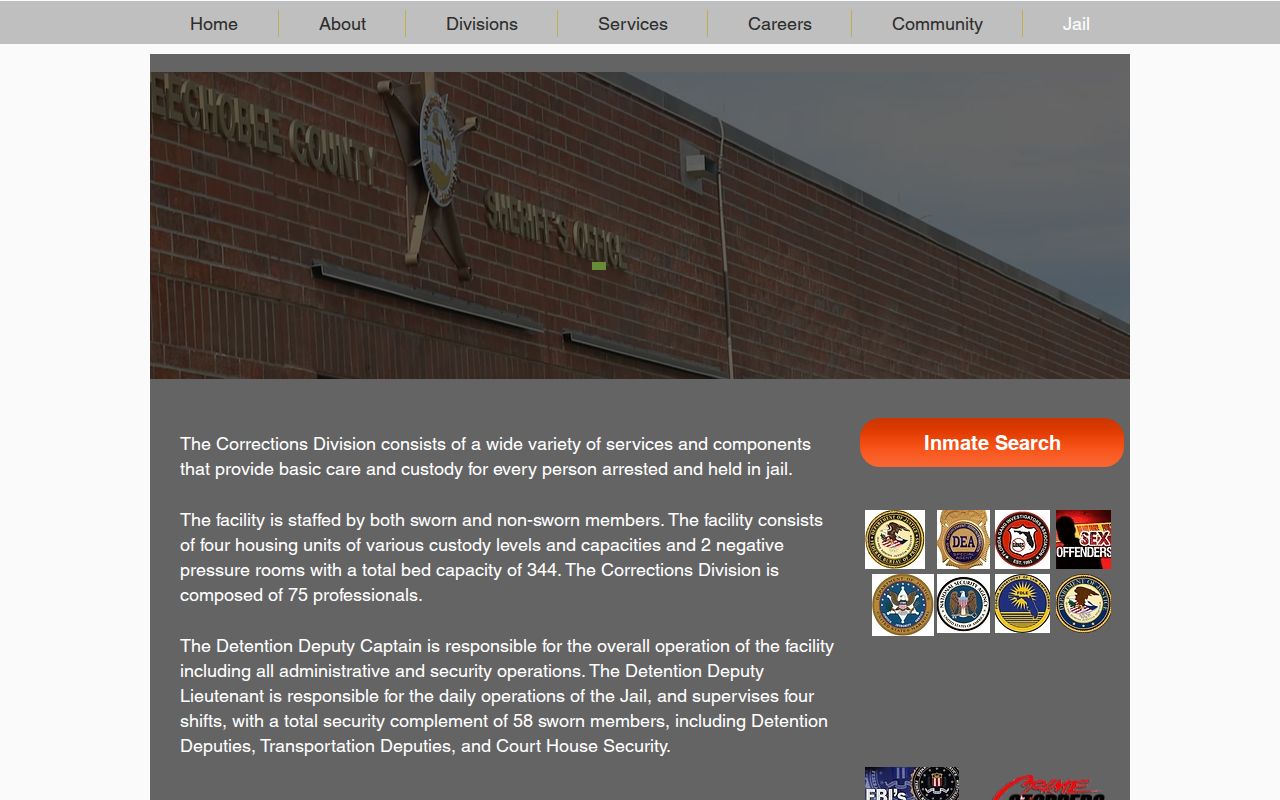
The image supports the facility facts and the presence of the sheriff's “Inmate Search” link, but that linked page still resolves to statistics rather than a person roster.
Okeechobee Jail Record Fields
A complete response may use labels that differ from the request wording. The returned record controls. Focus on facts that connect the booking, the court matter, and the end of the custody event. The most useful fields are shown below.
| Record element | Why it matters |
|---|---|
| Booking number and date | Separates the correct jail stay from another arrest. |
| Charges and case numbers | Connects the jail event to the Okeechobee court docket. |
| Bond and hold data | Shows conditions or another agency's claim on custody. |
| Actual release date and time | Records when OCSO processed the departure. |
| Release type or disposition | Distinguishes bond, court order, time served, completion, or transfer. |
| Receiving authority | Identifies the next system after a transfer. |
Bond release does not close the criminal case. A court-ordered release may retain conditions and hearing dates. “Time served” describes custody credit or completion reflected in the relevant record, not the end of every possible legal duty. If supervision follows, the FDC supervision record or court order provides that separate status.
Note: A web page's lack of a person-level result does not show that the sheriff destroyed the underlying booking or release record.
Two Okeechobee Release Systems
Okeechobee County has both the sheriff's 344-bed jail and the separate 1,632-capacity Okeechobee Correctional Institution. This distinctive local overlap deserves care. The jail handles local arrest and county-custody events. The prison holds people serving FDC sentences. OCSO Records is the source for a county booking and departure, while FDC's Corrections Offender Network is the route for state-prison status and release information.
Older audit material described a Main Unit, Work Camp, and Sago Palm Re-Entry Center arrangement at the state institution. Current FDC naming controls. Those historical components should not be turned into three current facilities. Likewise, a transfer from the county jail to Okeechobee CI is not a release just because both facilities share the county name.
Okeechobee Jail Release Limits
No official source reviewed supplied a fixed release-processing hour, a release exit, a family waiting area, a weekend or holiday procedure, a property-return policy, or a county-jail good-time rule. OCSO also promises no fixed records-request turnaround. These gaps must remain open unless jail staff provides a current policy. A nearby county's practice is not evidence of Okeechobee procedure.
For pickup planning, confirm logistics directly with the jail and avoid treating a court order as the moment the person will walk out. Staff may still need to check other holds and complete processing. When legal proof is needed later, retain the court order and obtain the OCSO release transaction rather than relying on a call, screenshot, or alert alone.
Okeechobee Jail Court Check
The anonymous Okeechobee OCRS criminal docket can show bond orders, dismissal, no information, nolle prosequi, plea, sentence, time-served credit, probation, modification, revocation, satisfaction, or closure. It helps explain why the jail stay ended. It does not establish the hour OCSO completed release. The jail transaction and court disposition should be read as two linked records.
For a certified disposition, the Okeechobee Clerk accepts requests at records@myokeeclerk.com and lists search, copy, and certification charges. Give the name, date of birth, and case number for a quote. Do not confuse OCRS with Landmark, which indexes recorded instruments rather than the criminal docket. When an order and OCSO status appear to conflict, ask each custodian about the event it controlled.
Okeechobee Jail Status Proof
The jail telephone and Records serve different needs. The published jail line can answer an immediate question about current charges or bond, but OCSO does not promise that the call will provide documentary proof of a past release. Records can locate the booking sheet and the existing release fields that remain useful after the custody event ends.
Florida VINE may provide a release or movement alert, yet feed timing and labels can vary. Use the alert to prompt an OCSO check. If the destination matters, the receiving-authority entry and the next agency's record resolve whether the person entered FDC, USMS, ICE, another county, or the community.